Video: How to Submit Your IT3(d) Effortlessly
“Save time and effort by using ActiveDonor’s platform to manage your 18A certificates and IT3D submissions. It’s so easy to use, my entire declaration took less than five minutes! It has definitely made my life much easier.” Ellie, Border Collie Rescue
If your organisation is approved to issue Section 18A tax certificates, SARS requires you to file an IT3(d) return twice a year listing every certificate you’ve issued in the period. ActiveDonor builds the SARS-compliant file for you, runs a compliance check on every certificate before it’s sent, and tracks SARS’ response against the certificates it relates to.
This article walks you through the full process, from one-time setup to reading SARS’ response.
In this article
- Before you start
- IT3(d) Settings (one-time setup)
- Choosing how to submit: ActiveDonor or self-submit
- Step 1: Open IT3(d) Management
- Step 2: Pick a tax period
- Step 3: Select the certificates to include
- Step 4: Run the pre-submission compliance check (new)
- Step 5: Submit or download your IT3(d) file
- Step 6: Read SARS’ response
- Reporting revoked certificates
- Filing a Null Submission
- FAQ
- Need help?
1. Before you start
You’ll need:
- An annual ActiveDonor subscription
- A SARS Section 18A approval letter and your PBO number
- Your tax/PBO numbers and reporting entity details ready
- The IT3(d) report permission on your user account
If your IT3(d) settings aren’t filled in yet, the IT3(d) Management page shows a banner that links straight to the missing screens. Set them once, then you’re done.
2. IT3(d) Settings (one-time setup)
Go to Reports → Tax & Compliance → IT3(d) submissions, then click the IT3(d) Settings button on the left.
There are four things to confirm:
- Submitting Entity: Choose ActiveDonor for one-click submissions to SARS, or Other if you prefer to download the file and upload it to eFiling yourself. See the next section if you’re not sure which to pick.
- Submission File Header: Required SARS metadata identifying the file. Fill it in once.
- Reporting Entity: Your PBO’s registered name, PBO number, tax reference number, physical and postal addresses, and contact details. These appear on every record SARS sees.
- Authorisation: If ActiveDonor is your submitting entity, accept the IT3(d) Submission Authorisation Agreement. This authorises us to submit on your behalf via SARS Connect Direct.
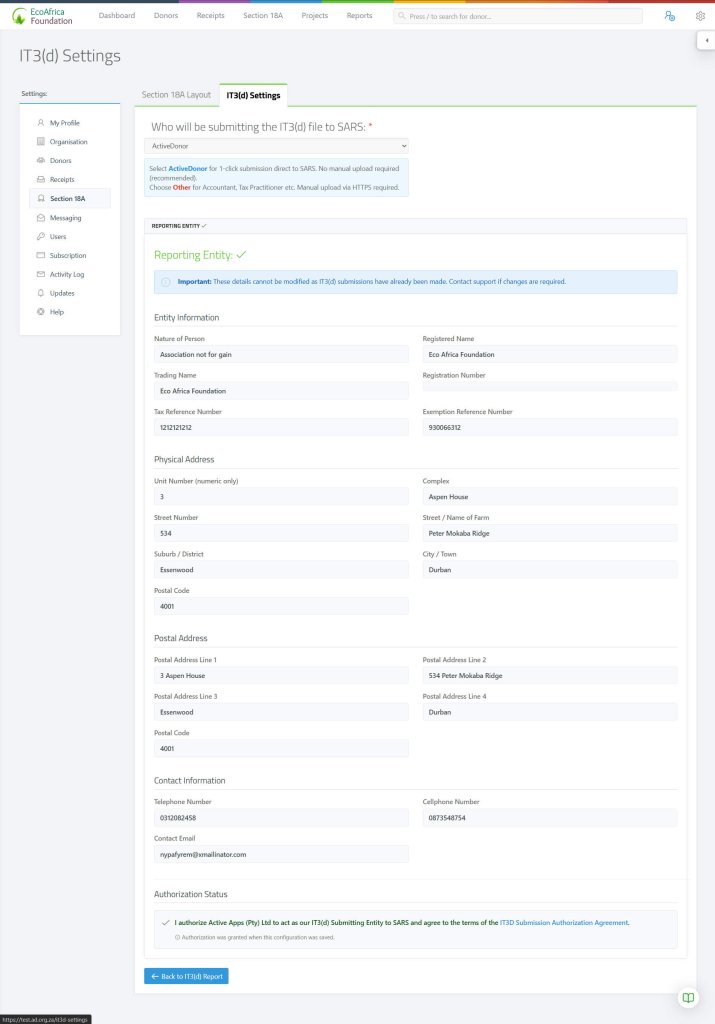
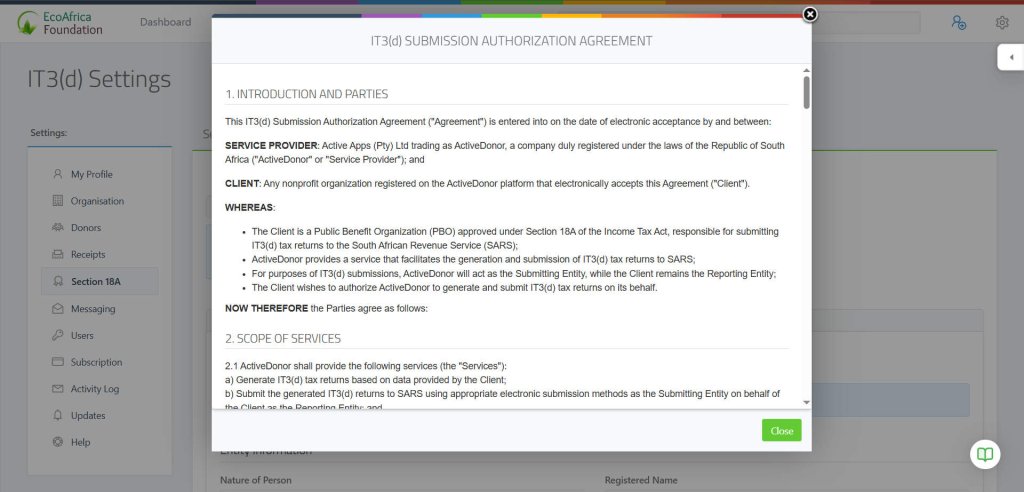
📌 Important: Once you’ve made your first successful submission, the Reporting Entity fields lock to read-only to prevent accidental changes mid-period. If you really need to change them, contact support.
3. Choosing how to submit: ActiveDonor or self-submit
You have two options for how the IT3(d) file actually reaches SARS.
Option A: ActiveDonor as submitting entity (recommended)
ActiveDonor uploads the file directly to SARS through their secure Connect Direct channel. You click Submit to SARS in ActiveDonor and the file is on its way, no eFiling step needed. SARS then sends the response back through the same channel, and ActiveDonor pins the results against your certificates automatically.
To use this option:
- In IT3(d) Settings, set Submitting Entity to ActiveDonor.
- Read and accept the authorisation terms.
The IT3(d) Management page will show a green Authorized to Submit: YES badge once this is done.
Option B: Other (self-submit)
ActiveDonor builds the IT3(d) file for you, but you download it and upload it to SARS eFiling yourself. Use this if your organisation prefers to keep the SARS submission step in-house.
In IT3(d) Settings, set Submitting Entity to Other and enter your organisation as the submitter.
Either option is valid. Option A is easier and lets ActiveDonor pull SARS’ response back automatically.
4. Step 1: Open IT3(d) Management
From the main menu, go to Reports → Tax & Compliance → IT3(d) submissions.
You’ll see three tabs at the top:
- Section 18A Issued: certificates ready to file
- Section 18A Revoked: corrections to send to SARS (only shown if you have any)
- IT3(d) Submissions: history of every file you’ve sent and SARS’ response
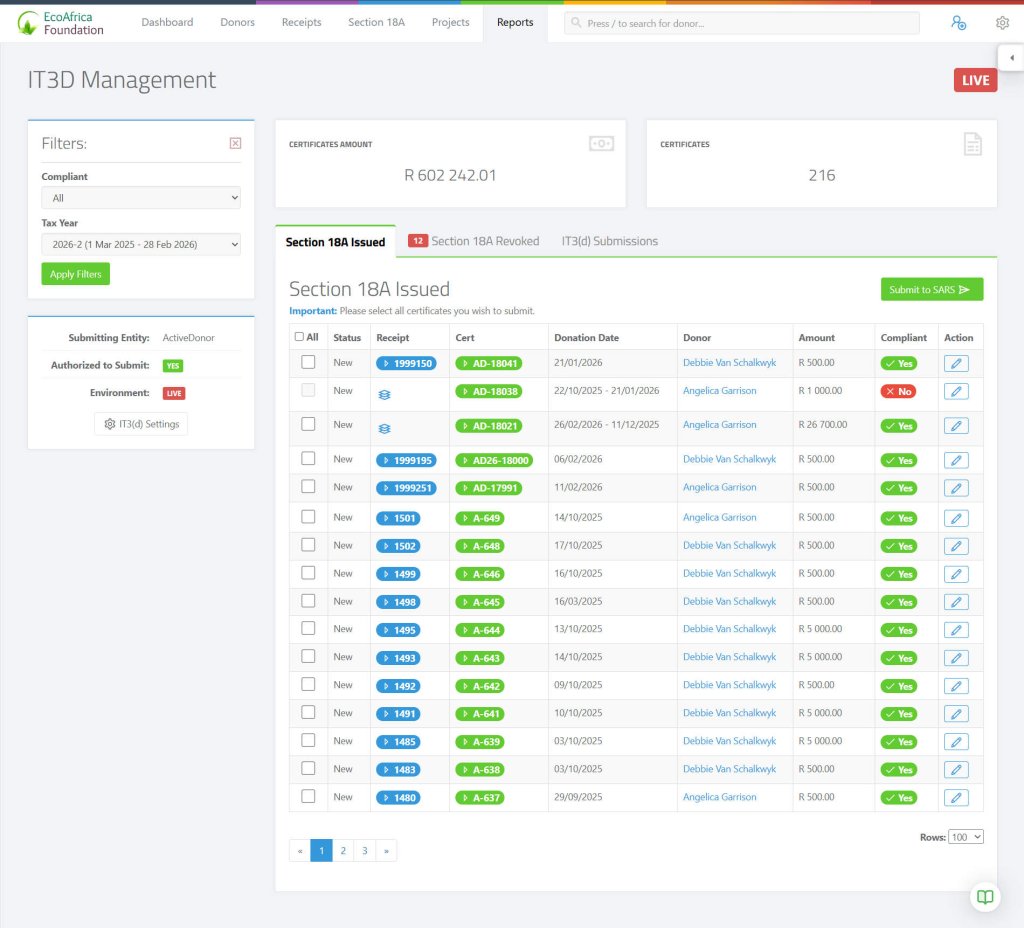
The sidebar shows your Submitting Entity, whether you’re authorised to submit, and whether you’re in TEST or LIVE mode.
5. Step 2: Pick a tax period
SARS splits each tax year into two reporting periods:
| Period | Covers | When you submit |
| YYYY-8 | 1 March to 31 August | September to October (mid-year) |
| YYYY-2 | 1 March to end February | May to June (year-end) |
The current default period (or most recent) will automatically be selected. Earlier periods are available in the dropdown.
📌 Why a certificate might be missing: ActiveDonor only shows certificates whose receipts all fall inside the period you’ve selected. If you issued a single batch certificate covering receipts in two different periods, it won’t appear here. Split the receipts so each batch falls inside one period.
6. Step 3: Select the certificates to include
Each row shows a certificate with its donor, donation date, amount, and a Compliant badge:
- 🟢 Yes: the certificate has all the data SARS requires
- 🔴 No: something is missing or invalid (for example tax number, address, ID number)
You can:
- Tick certificates one at a time, or use the All checkbox at the top of the column to select every compliant certificate
- Filter to Compliant: Yes / No / All in the sidebar to focus on problem rows
- Click any 🔴 row to open the certificate, see what’s missing, and fix it
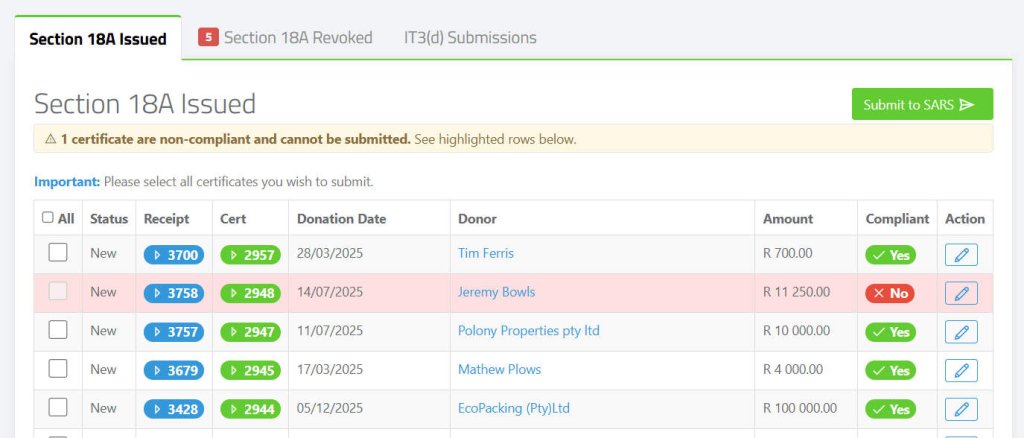
The two cards above the table, Certificates Amount and Certificates, update as you tick boxes so you can sanity-check the totals before you submit.
Fixing a non-compliant certificate
Click the pencil icon on the row. ActiveDonor highlights the exact fields that need attention.
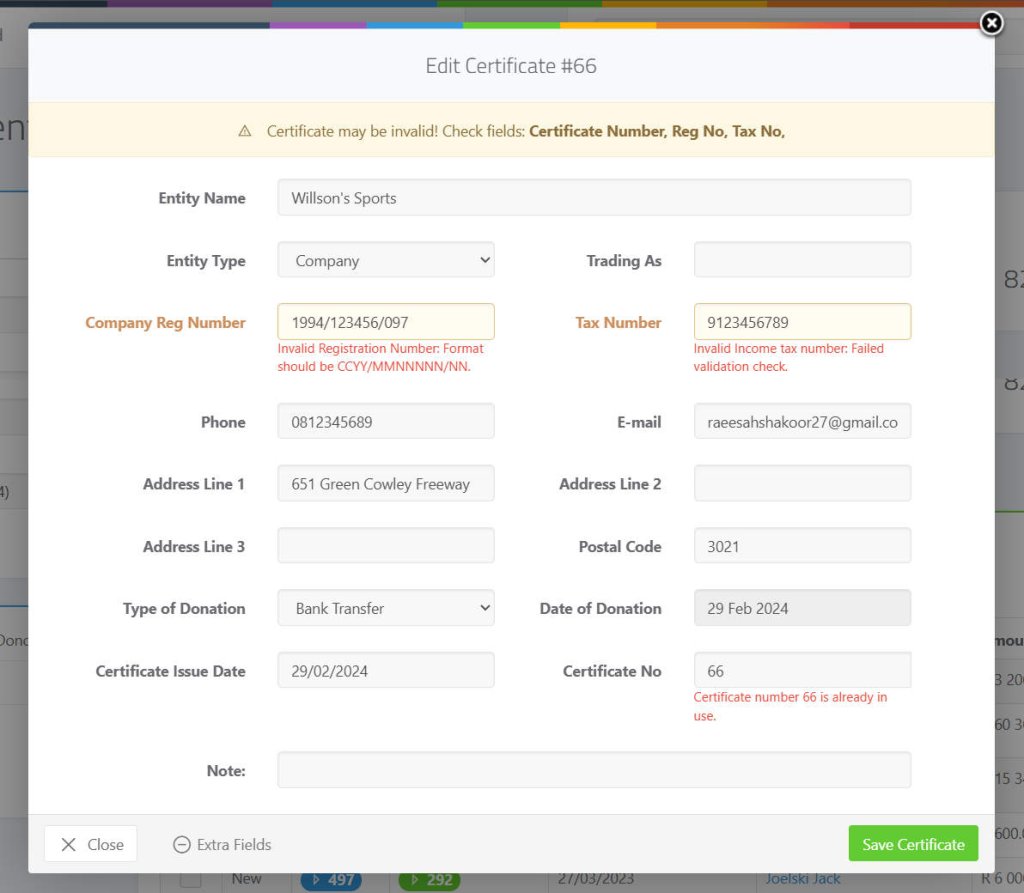
Common causes:
- Tax reference number is missing or invalid
- Company registration number isn’t in the format
CCYY/NNNNNNN/NN - Email address has an invalid TLD
- Postal address is incomplete
Save the certificate and return to the IT3(d) page. The compliance badge updates immediately.
7. Step 4: Run the pre-submission compliance check (new)
When you click Submit to SARS (or Download IT3(d) if you self-submit), ActiveDonor runs a fresh compliance check on every selected certificate. This catches issues that may have been introduced by edits since the page was loaded, before the file is built.
There are two outcomes.
Outcome A: Everything is compliant ✅
The IT3(d) file is generated immediately and either submitted to SARS (Option A) or downloaded to your computer (Option B). You’ll be redirected to the IT3(d) Submissions tab.
Outcome B: Some certificates aren’t compliant ⚠️
A confirmation popup tells you exactly how many of your selection are compliant versus non-compliant:
You selected 312 certificates:
- 🟢 311 certificates are compliant and ready for submission
- 🔴 1 certificate is non-compliant (highlighted in red)
Do you wish to proceed and submit the 311 compliant certificates?
You have two choices:
- Submit 311 Compliant Certificates. Files just the compliant ones now. Fix the rest later.
- Cancel, Review Highlighted Rows. Closes the popup so you can fix the data on the red rows and try again.
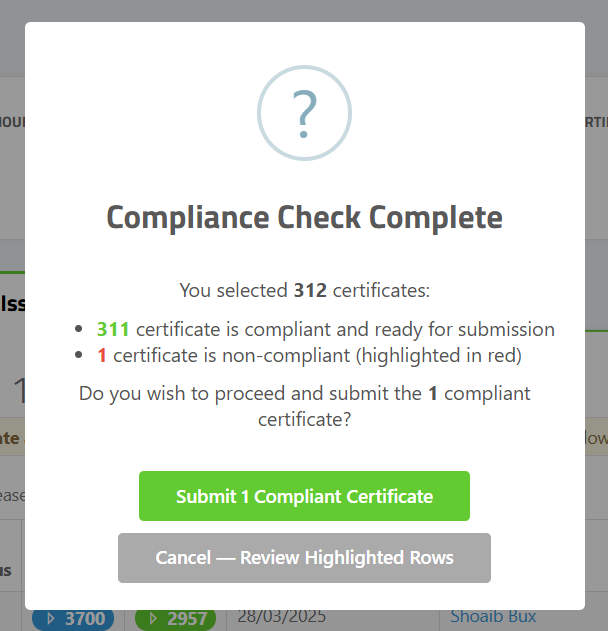
💡 Tip: If you almost always have a handful of stragglers, submitting the compliant subset and circling back to the rest in a later submission is perfectly fine. SARS treats each submission independently as long as it has a unique file ID.
8. Step 5: Submit or download your IT3(d) file
What happens next depends on your submitting entity.
If ActiveDonor is your submitting entity
- The file is uploaded to SARS via Connect Direct.
- A confirmation email is sent to your organisation’s email address, the user who clicked submit, and
[email protected]. - You’re redirected to the IT3(d) Submissions tab where the new submission shows as Pending while SARS processes it.
If “Other” is your submitting entity
- The IT3(d) file downloads to your computer with a confirmation email attached for your records.
- Log in to SARS eFiling and upload the file to your IT3 work page.
- Once SARS processes it, return to ActiveDonor. Your submission record is already there waiting for the response.
⚠️ For self-submitters: Do not rename the IT3(d) file. SARS rejects files with modified filenames.
📌 SARS typically returns a response within a few minutes to 48 hours. The IT3(d) Submissions page shows the average wait time based on your last few submissions, so you know roughly when to come back.
9. Step 6: Read SARS’ response
Open the IT3(d) Submissions tab. Each submission has a colour-coded status:
| Status | What it means | What to do |
| 🟢 Accepted | Every record was accepted. | Nothing, you’re done. |
| 🟡 Accepted with Warnings | All records accepted, but some flagged for data-quality issues. | Open the submission to see the warnings, and clean the data before next period. |
| 🟠 Partially Accepted | Some records accepted, some rejected. | Open the submission, fix the rejected certificates, and submit them on their own in a follow-up file. |
| 🔴 Structure Failure | The file itself was malformed and none of it was processed. | Contact ActiveDonor support. This should be very rare. |
| ⚪ Null Submission | An empty (no-certs) filing was accepted. | Nothing, you’re done. |
| ⏳ Pending | SARS hasn’t responded yet. | Wait. The page shows the average response time. |
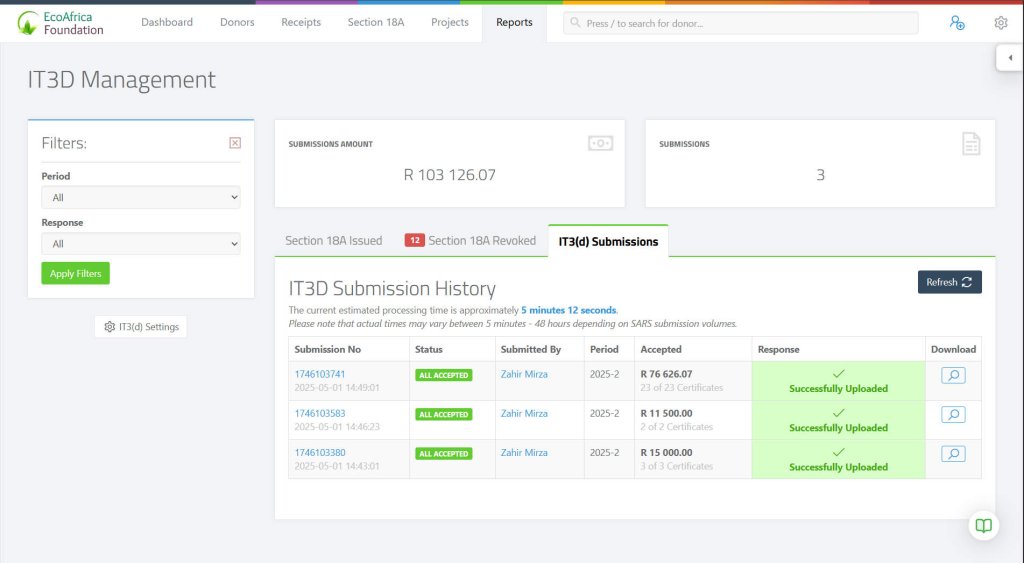
Click any submission to drill into the detail. For each certificate in the file you’ll see:
- The certificate number, donor and amount
- SARS’ specific error or warning text against that record
- A link to the certificate so you can correct it
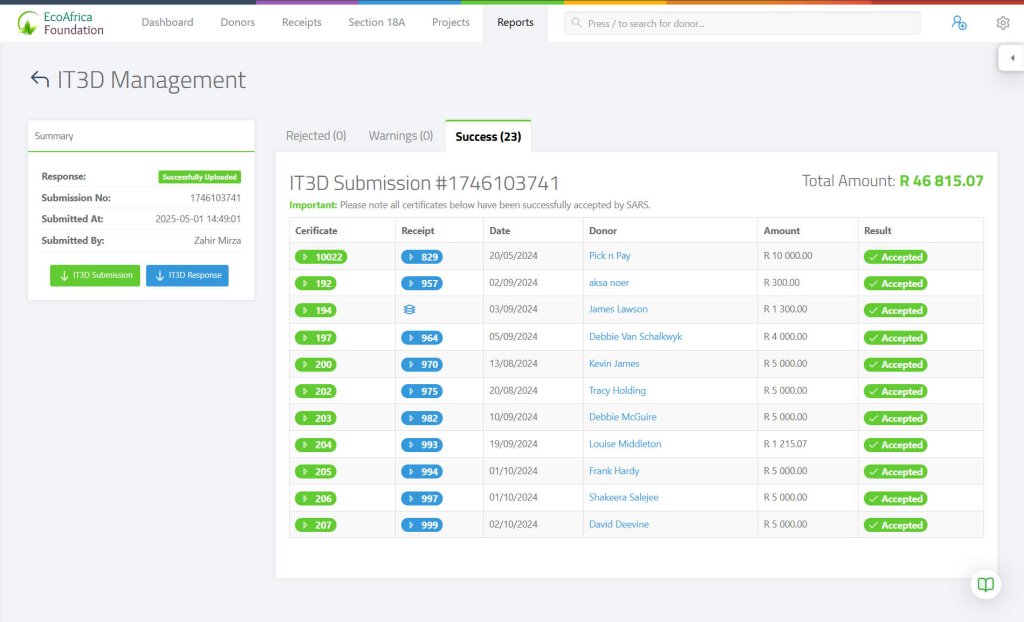
You can also download the original file you sent and SARS’ raw response file from the submission detail page, useful for your records.
10. Reporting revoked certificates
When you revoke a Section 18A certificate (because of a refund, donor cancellation or correction), SARS needs to know so they can remove the deduction from the donor’s return. Revoked certificates appear on a separate Section 18A Revoked tab, marked in red.
The submission flow is identical to issued certificates:
- Open the Section 18A Revoked tab.
- Pick the tax period that the original certificate was filed under.
- Tick the revoked certificates you want to report.
- Click Submit to SARS (or Download IT3(d)). The same pre-submission compliance check runs.
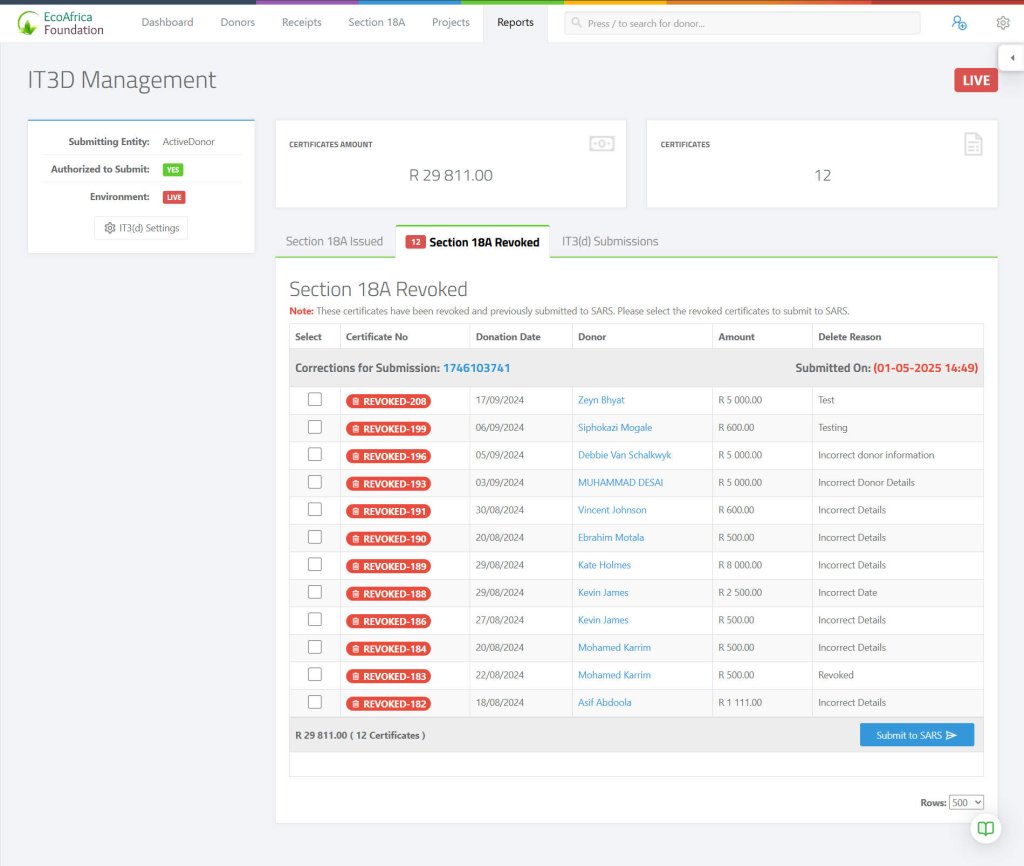
The revoked file is sent as a SARS “C” (correction) record, separately from your normal IT3(d) file.
📌 You only need to report a revocation if the original certificate was already submitted to SARS. Certificates revoked before they were ever filed simply drop out of the Issued list.
11. Filing a Null Submission
If you didn’t issue any Section 18A certificates in a given period, SARS still expects a return, called a Null Submission. ActiveDonor detects this automatically:
- Open IT3(d) Management.
- Pick the tax period.
- If there are no certificates to file, you’ll see a Submit Null Submission button.
- Click it. The null file is generated and sent the same way as a normal submission.
You can only send one null submission per period. If you’ve already filed one (or already filed certificates), the button disappears.
FAQ
How long does SARS take to respond?
Anywhere from a few minutes to 48 hours, depending on SARS’ submission volumes. Check the average wait time shown on the IT3(d) Submissions tab.
How do I know if I’m in TEST or LIVE mode?
The sidebar of the IT3(d) Management page shows an Environment badge: green TEST or red LIVE. Test files don’t go to SARS production systems, so you can use them safely while you’re learning the flow.
A certificate I expected to see is missing, why?
Three common reasons:
Already submitted. Once a certificate is in a successful IT3(d) submission, it won’t show up in the Issued list again. Look for it on the IT3(d) Submissions tab.
Wrong tax period. Check the Tax Year dropdown.
Can I edit the Reporting Entity details after I’ve submitted?
The Reporting Entity fields are locked once submissions exist for the tenant, to prevent accidental edits to historical filings. Contact support if a legitimate change is needed.
Why is a certificate I just fixed still showing as non-compliant?
The list refreshes when the page reloads. If you’ve edited a certificate, refresh the IT3(d) page or re-run the pre-submission compliance check. The check always queries the latest data.
Can I include non-compliant certificates anyway?
No. SARS will reject them, so ActiveDonor stops you before you waste a submission. The compliance check tells you exactly which ones to fix and lets you submit the rest in the meantime.
What if SARS rejects records in a Partially Accepted submission?
Open the submission, click into each rejected certificate to fix the underlying donor data (most common: missing tax number, postal code or ID number), then come back to Section 18A Issued. The corrected certificates will reappear ready for a new submission.
Who can see my IT3(d) submissions?
Only users in your organisation with the View Reports permission. Each submission also records which user filed it and when, in the activity log.
Does the file include receipts or only certificates?
Both. SARS expects one donor record per unique donor and one donation record per receipt. ActiveDonor builds these automatically from your certificate to receipt links. You don’t need to do anything extra.
Are batch certificates supported?
Yes, but a batch certificate whose receipts cross a SARS submission period boundary is filtered out of the index. SARS doesn’t allow a single certificate to span two periods, so split the underlying receipts across batches that fall inside one period.
My subscription says “Upgrade Required”, why?
IT3(d) submission is included in annual subscriptions (and some pre-November 2024 monthly plans). Trial and current monthly subscribers see an upgrade prompt. You can switch to an annual plan from Account → Subscription.
Need help?
If SARS returns a Structure Failure, or you see an error you don’t understand, contact us at [email protected]. Please include the Unique File ID of the submission so we can look it up quickly.
We’ve helped hundreds of PBOs file their IT3(d) returns and we’re happy to walk you through yours.
