Some donors may request a Section 18A tax certificate, which allows them to claim a deduction on their taxable income for donations made to your organisation.
Before you begin: A Section 18A certificate can only be issued once a donation receipt has been created. Make sure you have added the donor and captured their receipt first.
Issuing a Certificate
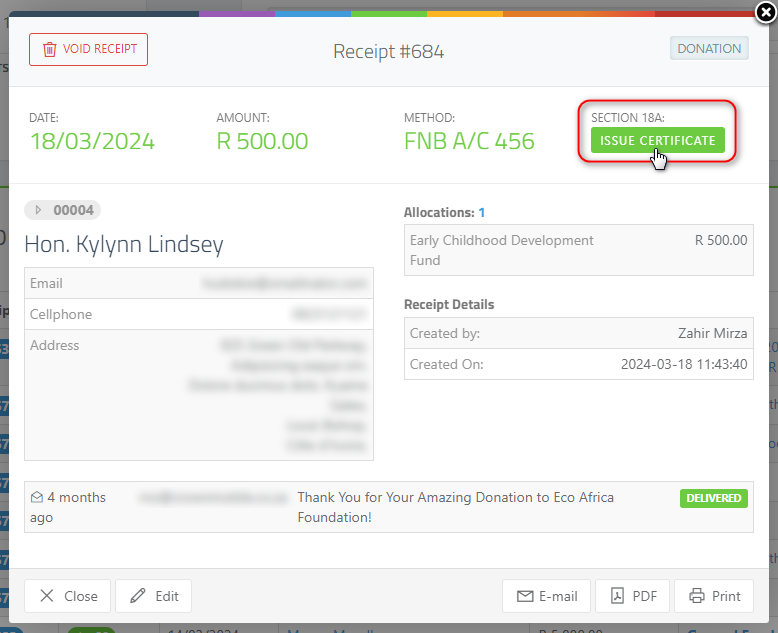
Option 1 – From the Receipt Pop-up
After capturing a donation receipt, an electronic receipt confirmation will appear on screen. Click Issue Certificate to open the certificate form.
Option 2 – From the Receipts Table
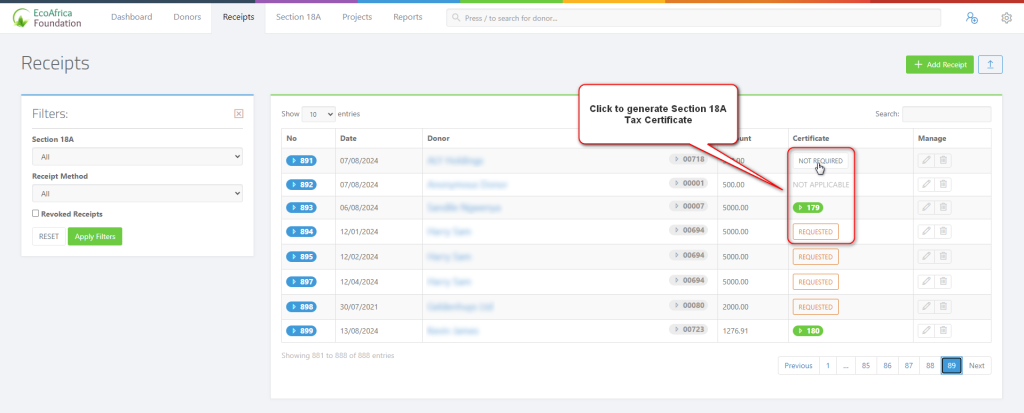
You can also generate a certificate at any time from the Receipts table:
- Click Receipts in the main navigation menu.
- Search for the relevant receipt by donor name, amount, or date.
- Click the Requested or Not Required status button on the receipt row to open the certificate form.
Completing the Certificate Form
Once the form opens, the donor’s details and receipt information will be automatically populated. Review and update any fields as needed before issuing.
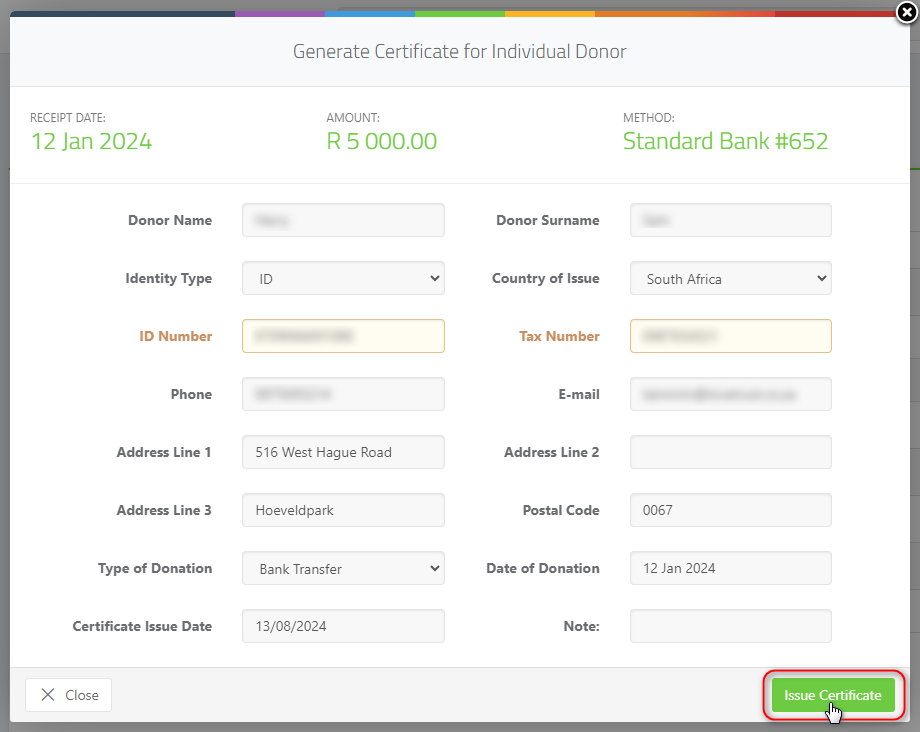
The form includes the following fields:
Donor Details
- Donor Name / Surname – Pre-filled from the donor record. Edit if needed.
- Identity Type – Select ID or Passport.
- Country of Issue – Country where the ID or passport was issued.
- ID Number / Tax Number – The donor’s SA ID number and income tax reference number.
- Phone / Email – Donor contact details.
- Address – Three address lines and a postal code.
Donation Details
- Type of Donation – Select the appropriate method: Bank Transfer, Cash Deposit, Cheque Deposit, Card Payment, Cash, or Goods in Kind (see below).
- Date of Donation – Automatically populated from the receipt and cannot be changed here.
Certificate Details
- Certificate Issue Date – Defaults to today’s date. You can change this if needed.
- Certificate No – Automatically assigned in sequence (e.g. AD-17979). You can enter a custom number, but note that this will update the numbering sequence for all future certificates.
- Note – An optional short note that will appear on the certificate.
Goods in Kind Donations
When Goods in Kind is selected as the Type of Donation, additional fields will appear to capture the required information for SARS compliance:
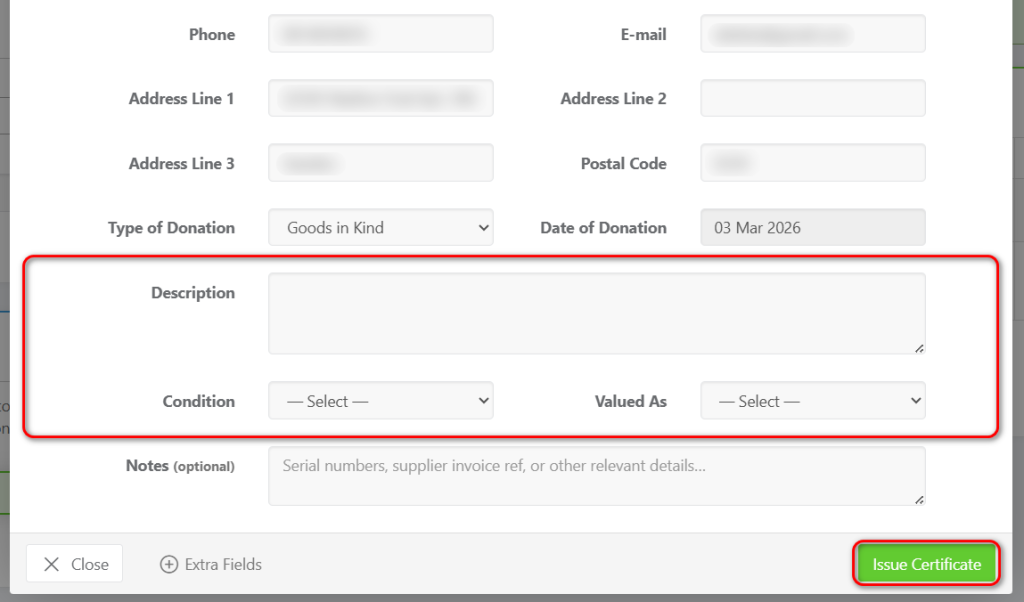
- Description – A clear description of the goods donated (e.g. School uniforms, books and supplies for Special Hearts Primary School). This is a required field and will appear on the certificate.
- Condition – The condition of the donated goods. Options: New, Used – Good, Used – Fair, Refurbished, N/A (Consumables), Mixed.
- Valued As – The basis on which the goods were valued. Options:
- Cost to donor – The donor provides proof of what they actually paid for the goods (invoice, receipt, purchase order). This is the most defensible basis because there’s a paper trail. Example: a company donates laptops they bought for R6,200 each and provides the supplier invoice.
- Donor declared – The donor states (“declares”) the value themselves without necessarily providing a purchase receipt. Common with individuals donating personal goods where the original cost isn’t easily available. Example: someone drops off 3 boxes of clothing and declares it’s worth R6,500. The nonprofit takes the donor at their word. This is the most common for ad-hoc donations but also the weakest from a SARS perspective.
- Market value estimate – The nonprofit (or donor) estimates what the goods would sell for on the open market at the time of donation. Used when original cost isn’t known or isn’t relevant – particularly for perishables, commodities, or goods where market price is easily verifiable. Example: a farmer donates 50kg of potatoes and you check the current wholesale price per kg.
- Independent valuation – A qualified third party (valuer, appraiser) provides a formal valuation. Typically only used for high-value or hard-to-value donations like property, vehicles or specialised equipment. Example: a donor gives a vehicle and a motor dealer provides a written trade-in valuation.
- Cost to donor – The donor provides proof of what they actually paid for the goods (invoice, receipt, purchase order). This is the most defensible basis because there’s a paper trail. Example: a company donates laptops they bought for R6,200 each and provides the supplier invoice.
- Notes (optional) – Any additional detail such as serial numbers, supplier invoice references, or other relevant information (e.g. Uniforms for Grade 1 & 2).
These fields are required to produce the Schedule: Donation of Property in Kind that is appended to the certificate (see below).
Batch Certificates (Multiple Receipts)
If a donor has made several donations over a period, you can combine them into a single certificate covering all receipts.
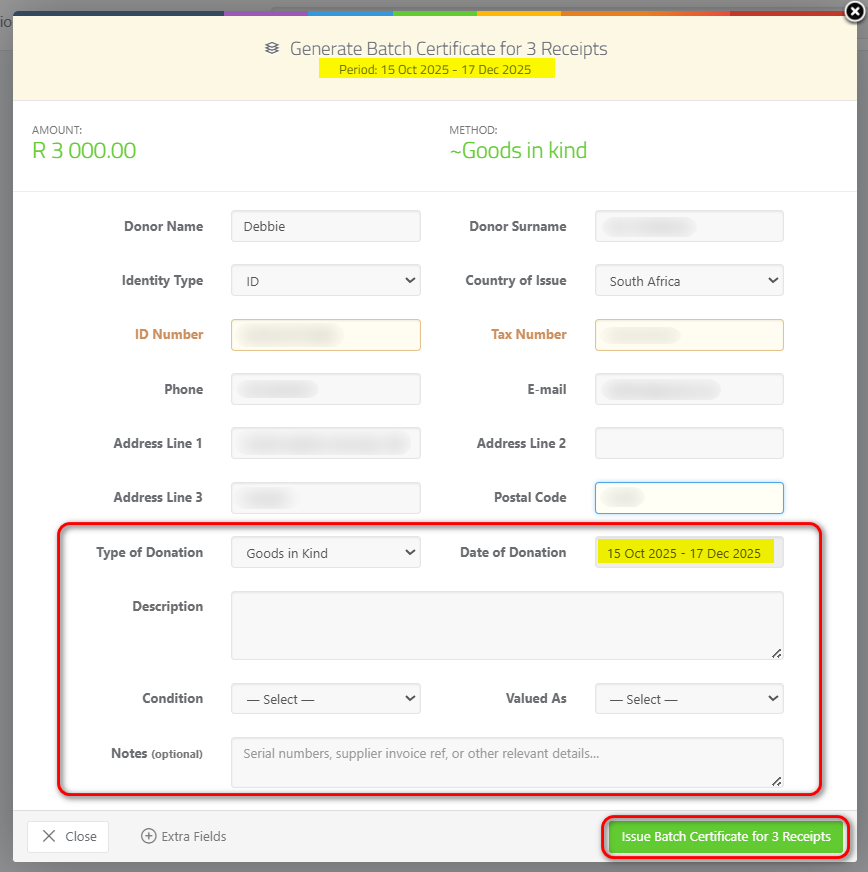
The batch certificate form works the same way as the individual form, with two key differences:
- The header will show the number of receipts included and the date range (e.g. 15 Jan 2026 – 25 Feb 2026).
- The Donation Amount reflects the combined total across all selected receipts.
All the same fields apply, including the Goods in Kind fields if applicable.
What the Certificate Looks Like
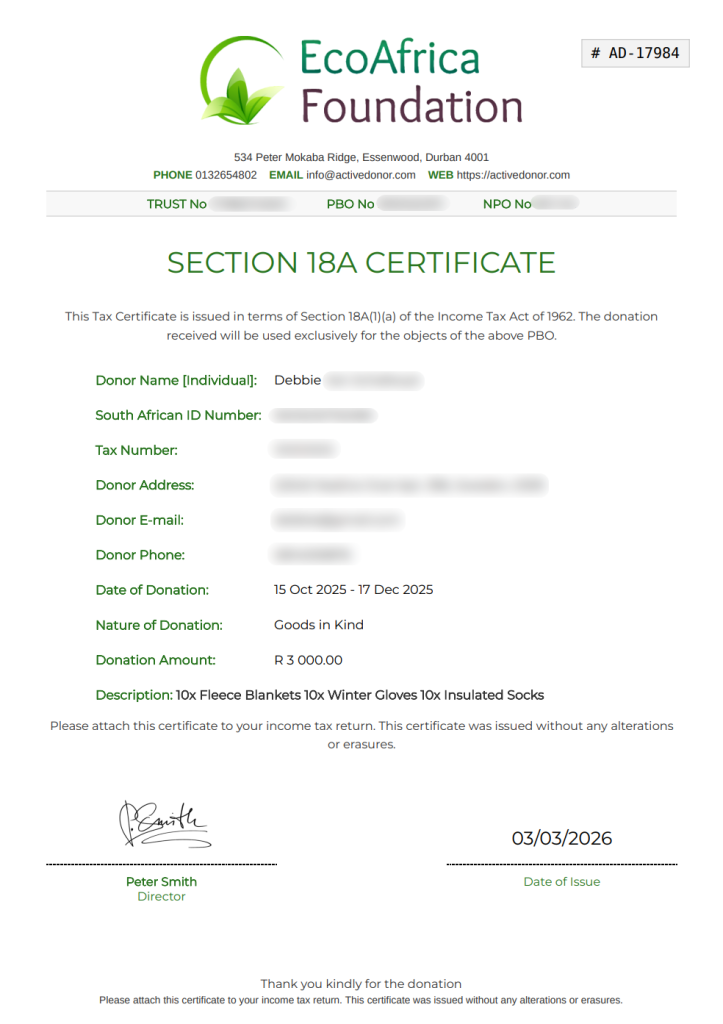
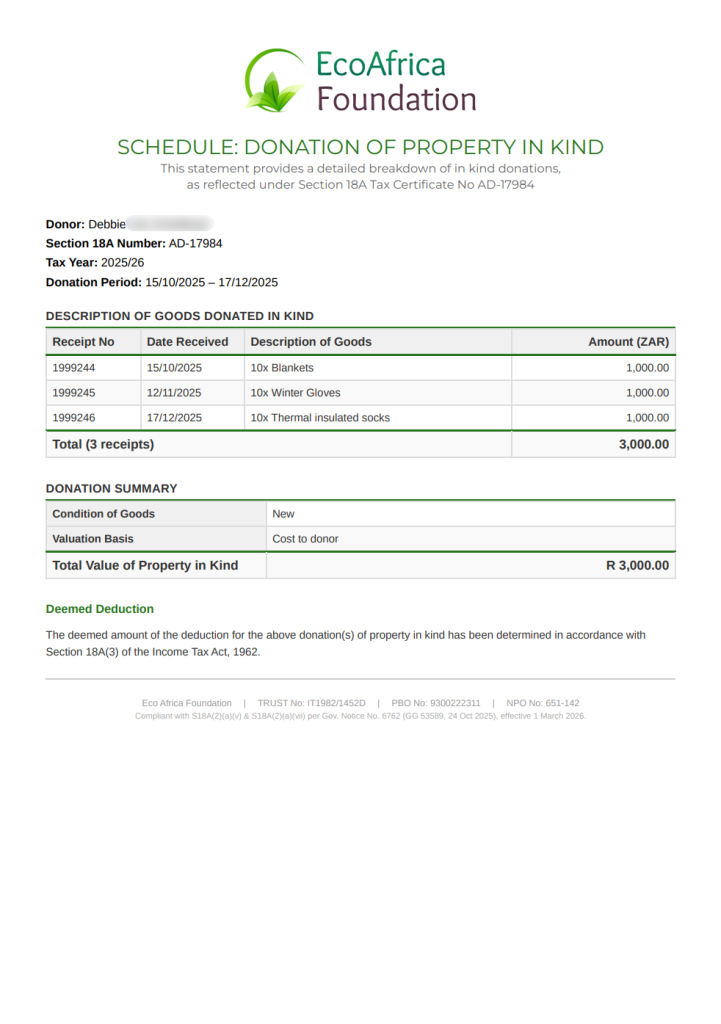
Once issued, the certificate is generated as a PDF. For Goods in Kind donations, the PDF includes two pages:
Page 1 – Section 18A Certificate The main certificate includes the donor’s details, donation date range, nature of donation, total amount, and description of goods.
Page 2 – Schedule: Donation of Property in Kind A detailed breakdown listing each individual receipt, including the date received, description of goods, and amount. The schedule also summarises the condition of goods, valuation basis, and any additional notes.
Signatures
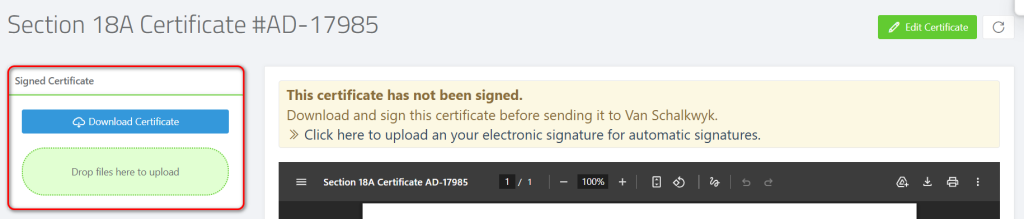
Automatic electronic signature: If you have enabled an electronic signature in your settings, it will be applied automatically and the certificate is ready to send.
Manual signature: If you have not set up an automatic signature, download the certificate, print it, have it signed, then scan and upload it back into ActiveDonor using the Drop files here to upload area on the certificate page.
Emailing the Certificate
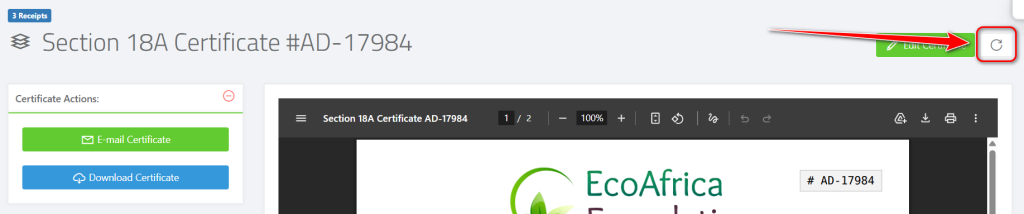
Once the certificate is issued and signed, click E-mail Certificate to send it directly to the donor from within ActiveDonor.

Regenerating a Certificate
If you have previously issued a certificate that does not reflect your latest settings – such as an updated logo, NPO number, or PBO number – you can refresh it using the Regenerate button in the top right corner of the certificate page. This will rebuild the certificate using your current settings without changing any of the donation details.